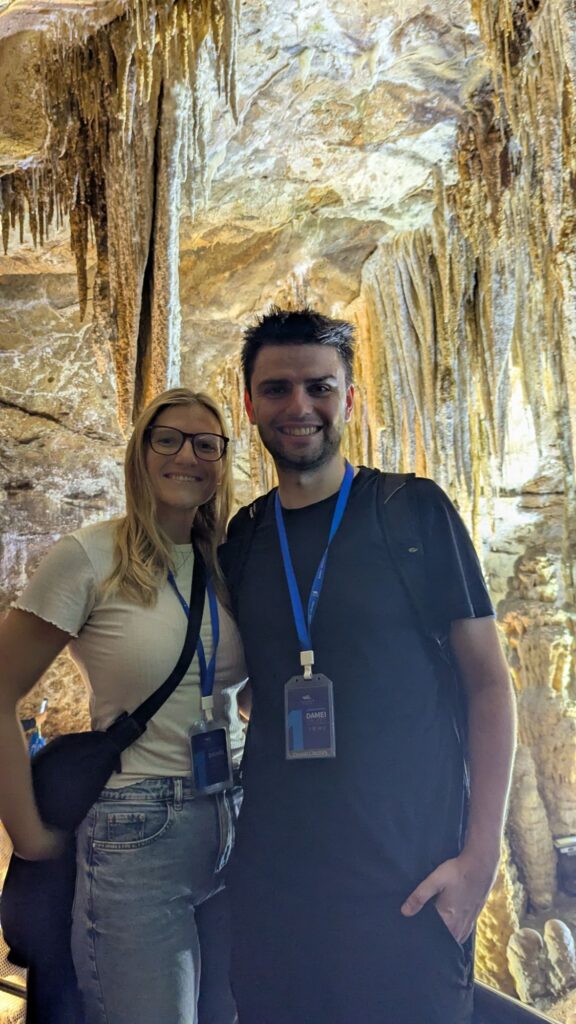
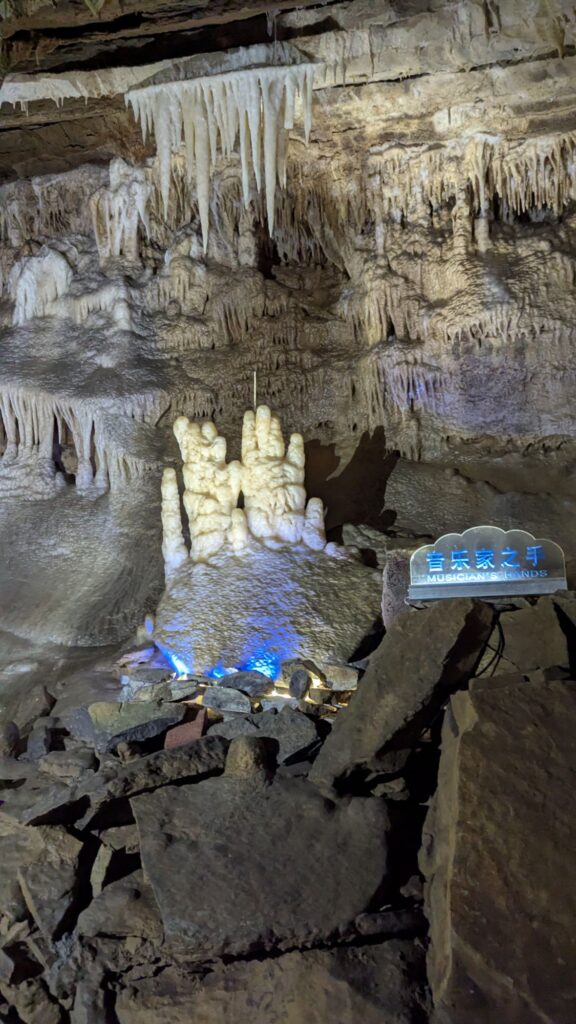
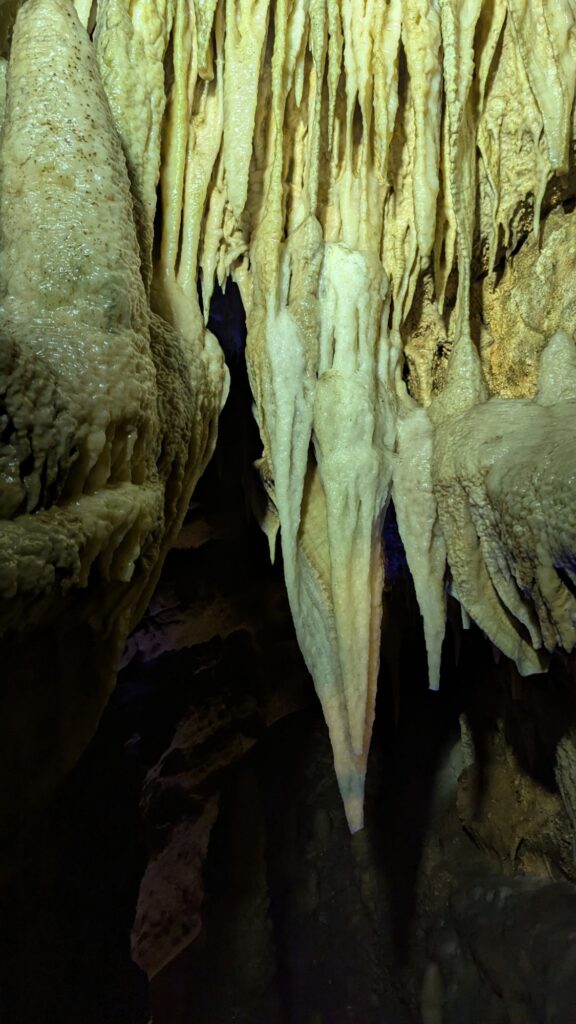
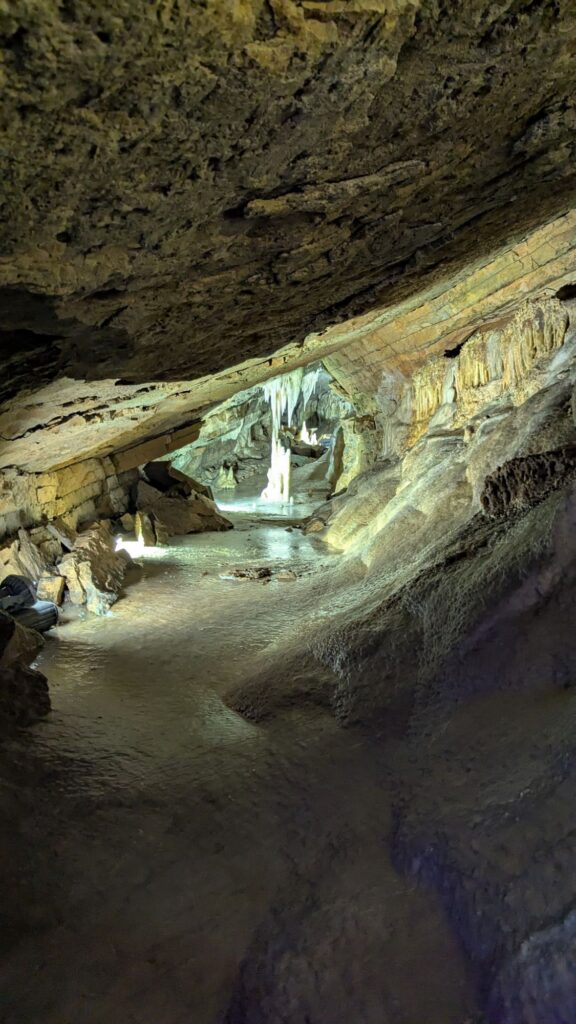
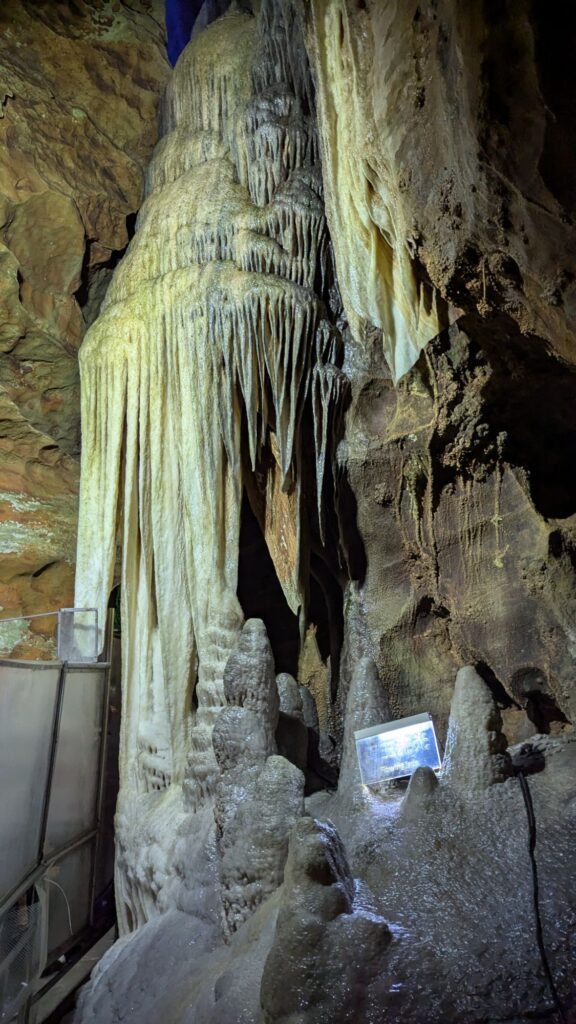
Today we enjoyed the luxury of a lie-in and a late breakfast (by cruise standards, at least) from 7:30 am. Immediately after eating, we docked and were bundled into a very old, janky-looking bus to head to today’s attraction, the Snowy Jade Cave. It is a large cavern filled with calcium deposits forming stalactites and stalagmites (the snowy part), some of which feature mineral deposits and green jade-like hues (the jade part).
First, we actually had to get there, which proved to be a heroic effort for our struggling vehicle. The poor bus groaned at every slight incline. At one point, we were moving so slowly that two other buses tried to overtake us simultaneously, right as a motorized rickshaw was coming from the opposite direction. It was a miracle we all made it through in one piece, although our hearing took a permanent hit from all the hectic horn-beeping.
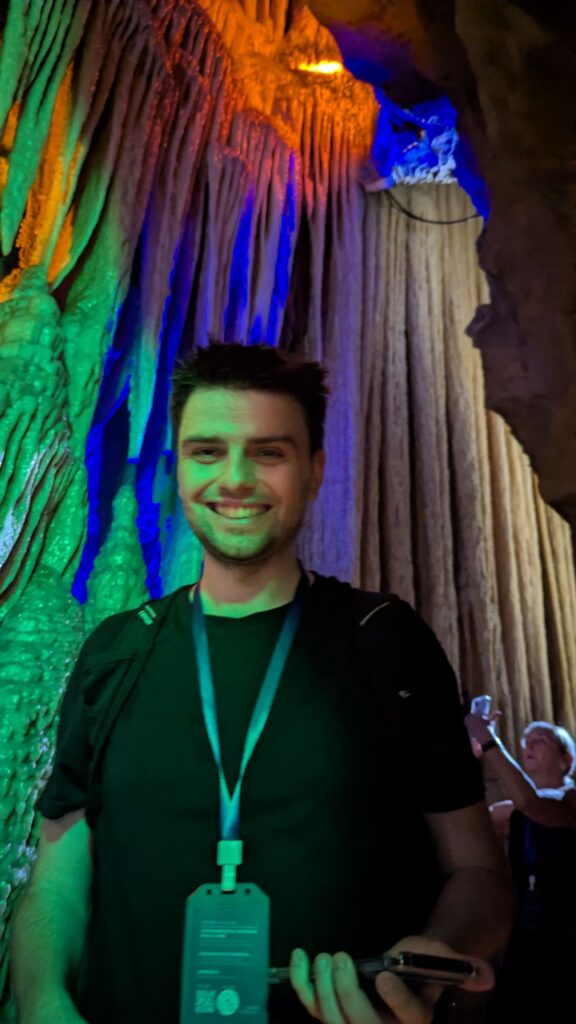
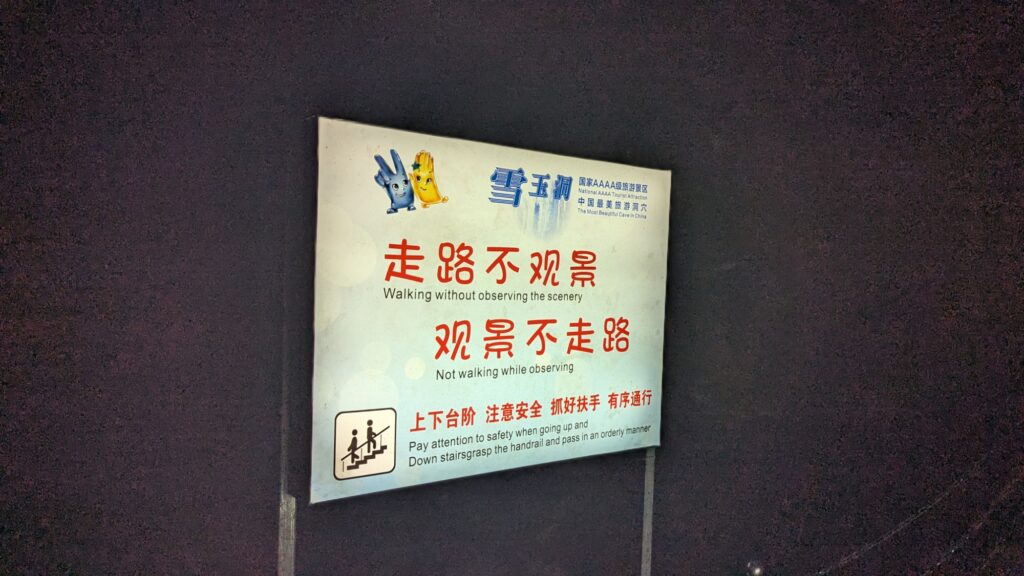
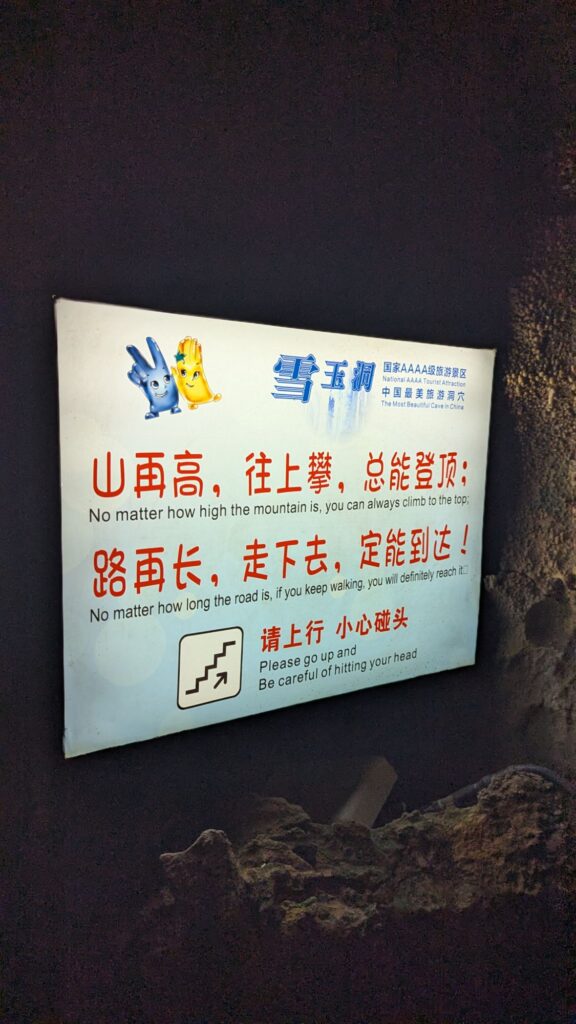
Thankfully, we arrived safely and walked the final stretch to the cave entrance, accompanied by a few curious macaque monkeys. Exploring the cave was great fun. Some sections opened into massive caverns while others squeezed down to tight crevices we had to inch through. Naturally, almost every calcium deposit was named after whatever object or mythical creature it vaguely resembled, of course being China there were several dubious looking ‘dragons’. There was a lot of colorful lighting but sadly this time there was no smoke machine. We also got a kick out of the signs along the path, which transitioned from helpful safety advice to deeply inspirational life advice the higher up the steps we climbed.
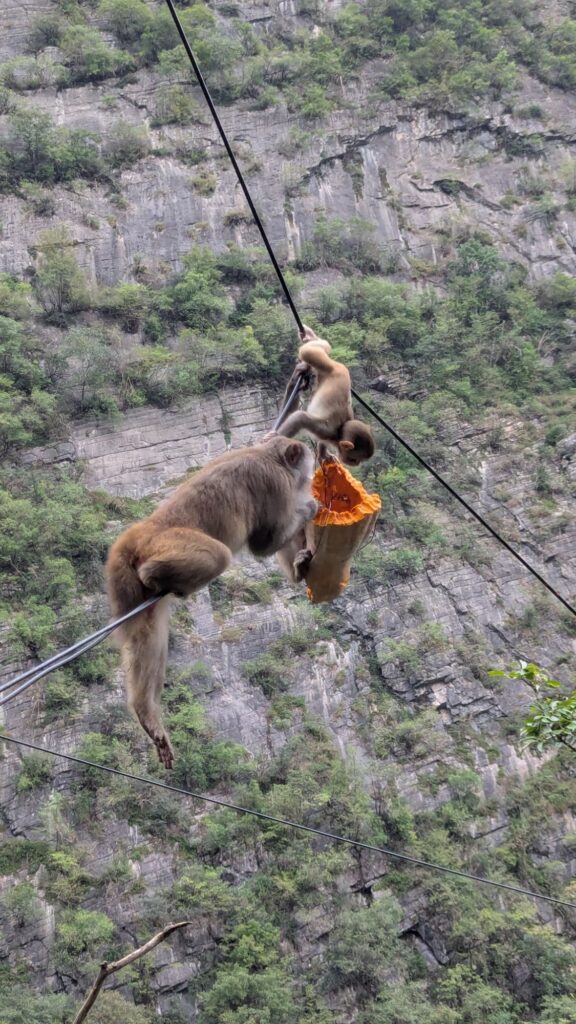
After finishing the tour, we had some spare time before heading back, so we sat down to watch the local monkeys. The park authorities had tied large squashes up in the trees to keep the animals fed and close enough for photos, explicitly to discourage tourists from feeding them directly. Big signs everywhere warned that feeding the monkeys turns them into aggressive pests.
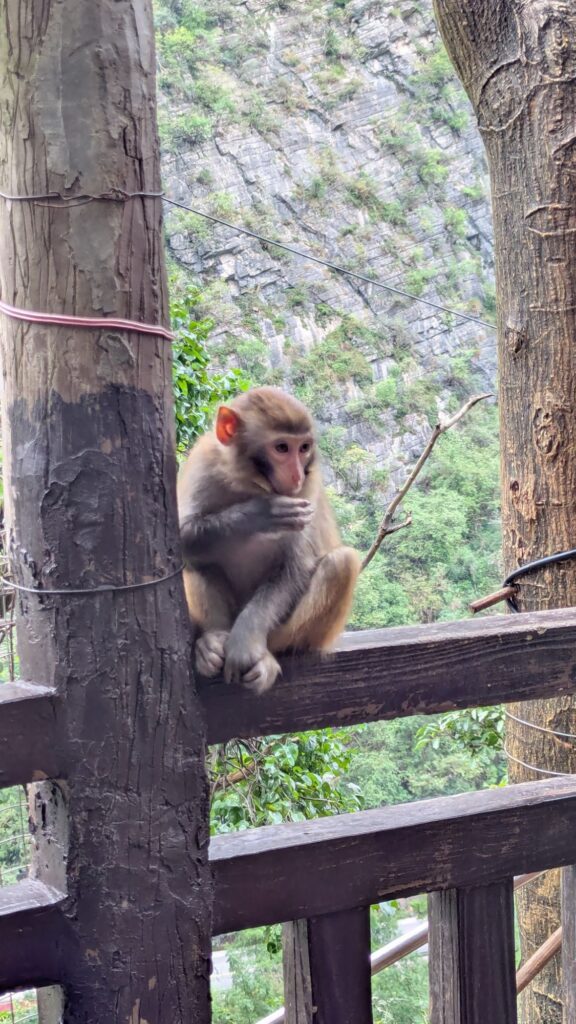
Unfortunately, a few Chinese tourists ignored the rules entirely, using peanuts to lure monkeys onto their laps for photo ops. This worked brilliantly until the peanuts ran out. The moment the snacks disappeared, the monkeys grew annoyed and started tugging at the tourists’ hair and clothes to demand more. The tourists managed to break free unscathed, but mere moments later, they were right back at it, randomly poking a monkey sitting on a handrail in the stomach. We decided to head off and leave them to it, as a painful lesson seemed inevitable and we had no desire to stick around to watch it.
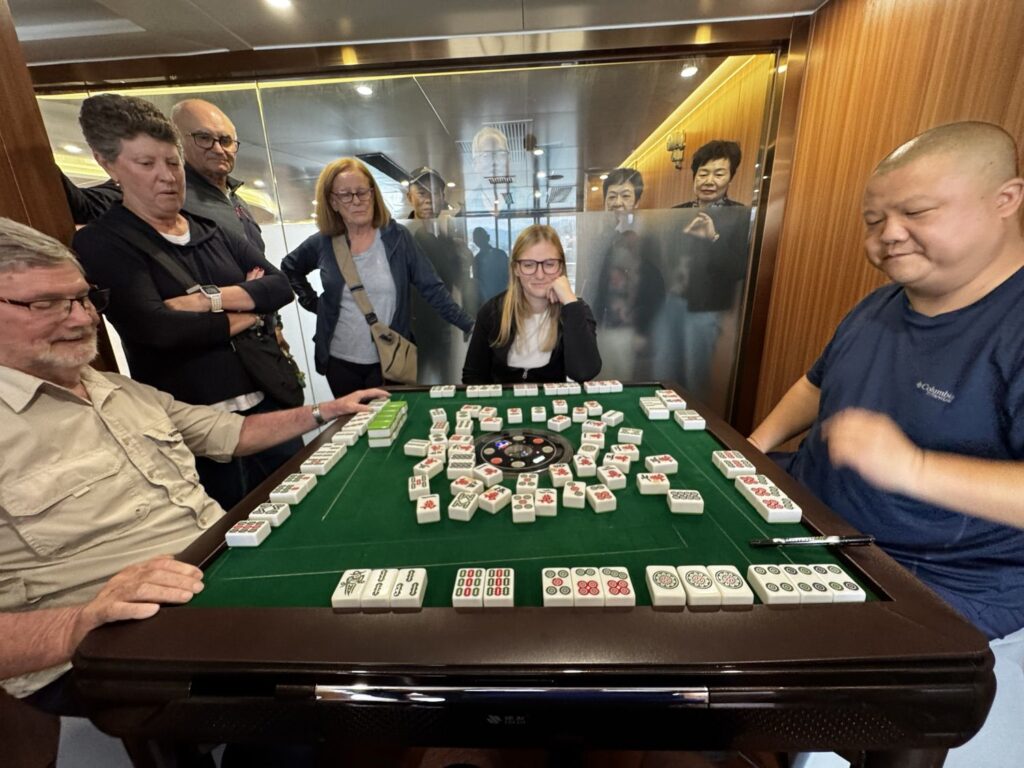
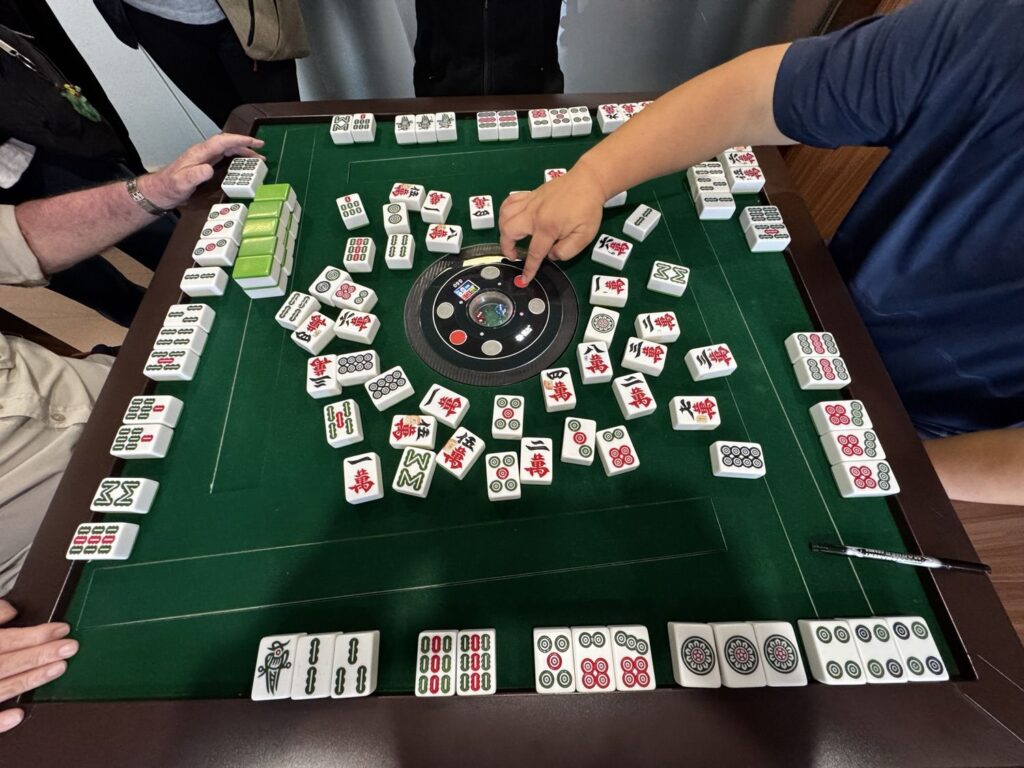
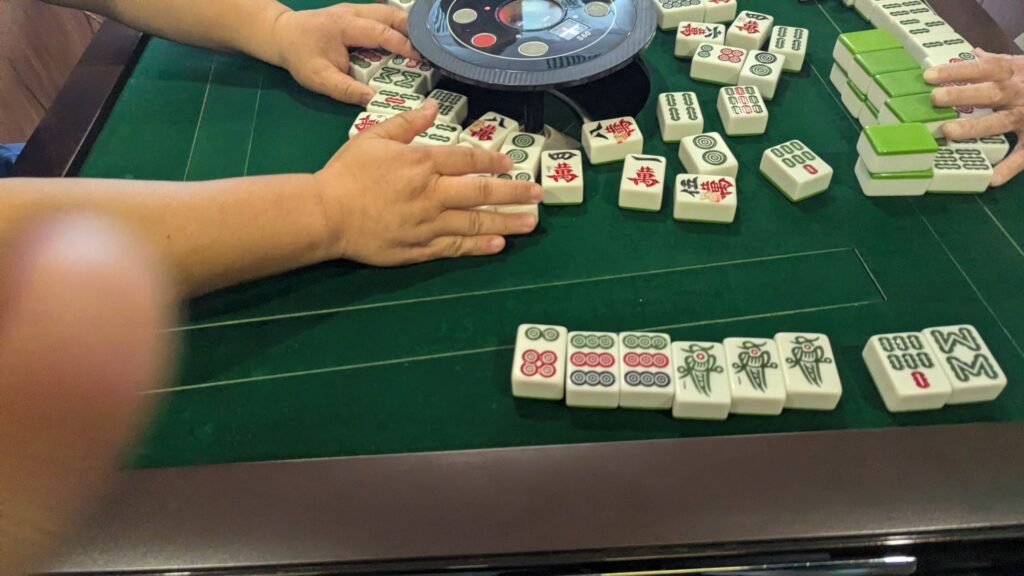
We piled back into our janky bus and trundled down to the dock, thankfully without further incident. Once back on board after lunch, we had a free afternoon, so our guide Michael offered to teach us Mahjong. It turned out to be surprisingly easy to pick up, playing much like rummy or other set-matching games, though Michael did have to write numerical values on the tile suite with Chinese characters so we could read them.
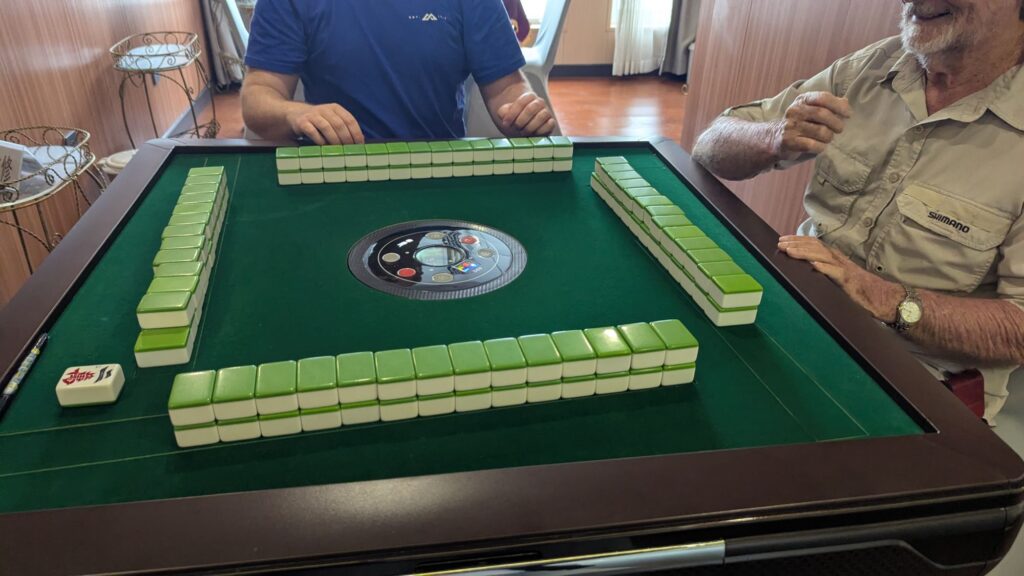
The best part of the whole experience was the table itself. It featured a built-in automatic dice roller in the center to determine who started and where to split the tiles. At the end of a round, the center raised up to reveal a mechanism into which you swept all the tiles. The table then shuffled, sorted, and neatly stacked them back into rows before pushing them back up for the next game. It was extraordinarily snazzy.
The four of us spent about two hours playing. Michael seemed genuinely pleased that we enjoyed it so much, circling the table to check our hands and offer tips. A crowd of Chinese guests gathered around to watch us play, which added a touch of performance pressure. Luckily, everyone won a couple of hands, so there were no sore losers in the group.
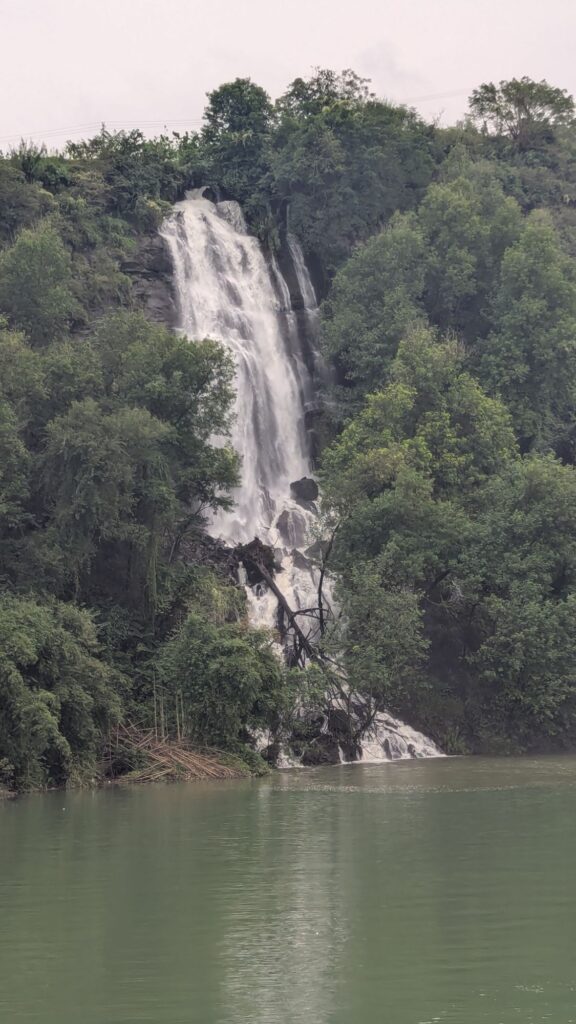
Afterward, we retreated to our room and finally had time to sit back and relax on the balcony for a bit before dinner. It was a nice way to relax and enjoy the scenery without the crowds. We even saw a pretty waterfall.
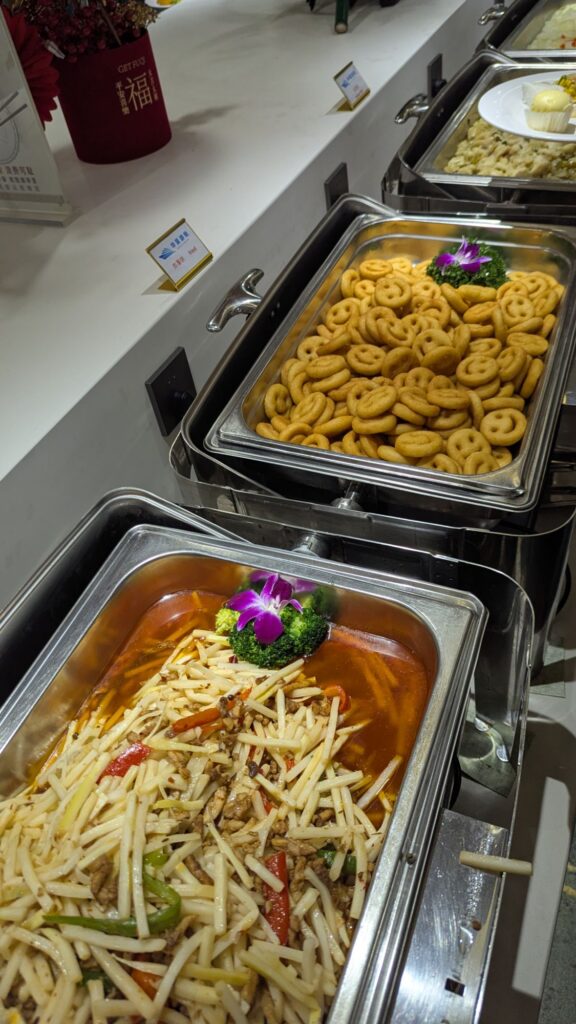
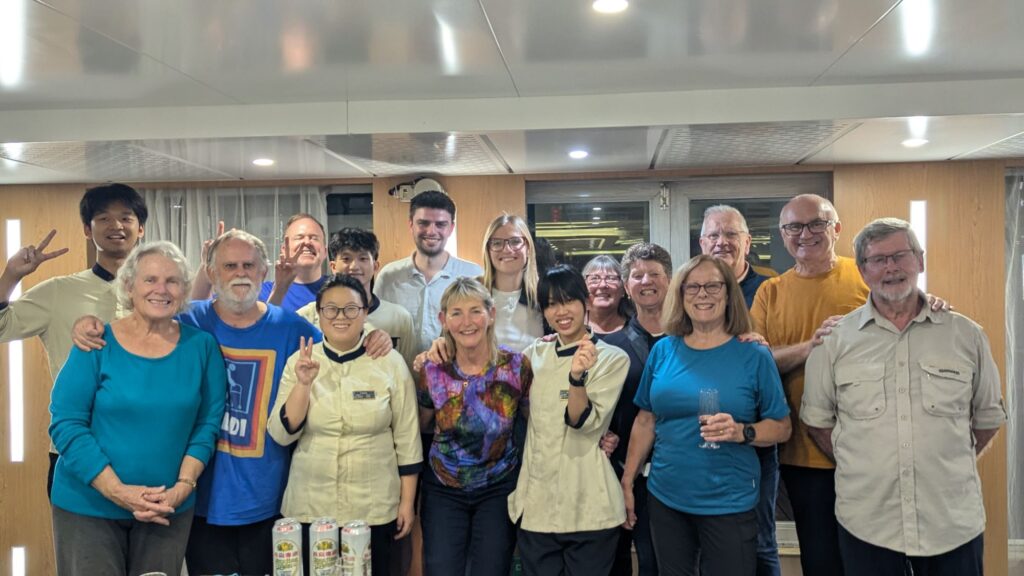
In the evening we enjoyed our final dinner on the boat another buffet of Chinese food, however this time we recognised some familiar faces… Smiley potato faces that is! Not quite sure these are a Chinese delicacy but we still enjoyed them! After a few photos requested by the kind dinner staff we headed back to our room to pack.
Tomorrow we head to Yangshuo, making a stop off in Chongqing, the largest city in China and in fact, the largest city in the world! Home to 32 million people! Hopefully we don’t get lost…
The traditional backpacking route involves taking the scenic train between Kandy and Ella, but we’ve decided to break up that journey a bit since there are two stops we want to make along the way—the first being Dalhousie. We didn’t manage to get pre-booked tickets from Kandy to Hatton (the station nearest Dalhousie), but we heard that you could buy third-class tickets on the day. When we asked at our hostel, they kindly came up with a plan for us. With the hostel staffs limited English, Grace and I didn’t fully understand all the details—other than that it would involve a tuk-tuk and one of the hostel staff—but we went along with the plan, hoping for the best and just going with the flow.
The tuk tuk took me, Grace, and Kevin—the hostel worker—to the station before Kandy. We bought three tickets and boarded the packed third-class section of the train. Kevin asked around and found people who were getting off at the busy Kandy station, so he had us ready to nab their seats. Once we reached Kandy, we stowed our bags and sat down while everyone else, including Kevin, disembarked. Within seconds, the carriage was filled up again, and the backpackers who boarded last—with their bulky bags—had to stand for most of the journey, while we enjoyed comfortable window seats. We were very pleased with the hostels cunning plan—even if the tuk tuk driver did scam us a bit for the ride, knowing we were in a rush!
The train ride itself was incredibly beautiful, winding up into the mountains and offering stunning views of rivers, valleys, and tea plantations. As we ascended, the air grew noticeably cooler. I actually enjoyed the third-class experience—people watching the locals was far more entertaining than I imagine the second-class seats would have been.
We even got brave and shared some snacks from one of the train vendors with a French couple—deep-fried chickpea and sweetcorn fritters. The vendor was also selling prawns, but we decided that seafood on a hot train was an almost suicidal idea for our sensitive stomachs.
We got off the train at Hatton and hopped on a bus to Dalhousie. It turned into a stressful, lengthy drive along twisty, narrow mountain roads. Our driver acted as if he were auditioning for the Grand Prix, and the other drivers weren’t any better. At one point, while rounding a narrow corner we were overtaking a logging truck while a tuk-tuk attempted to undertake us. Thankfully, Sri Lankan roads are well maintained—or I’m not sure we’d still be here to tell the tale!
We signaled to get off the bus and had to climb over a pile bags to do so. Grace managed to get her foot stuck, and lost her shoe in the process of freeing it —much to the annoyance of the driver and conductor, we were adding seconds to their lap time! Once Grace had recovered her shoe, they practically shoved us out the door, and were off.
We almost collided with an elderly lady, who turned out to be our homestay host. She was about 80, very lovely, though she spoke very little English. We had hoped to explore the “village”—and I use that term loosely, as it was just a few brick houses, two shops, a restaurant, and some shanty houses—to find some food, since it was already 4 p.m. and all we’d had was a shared fritter. However, using the little English she knew, our host informed us she would start cooking dinner for us. Feeling guilty about refusing her offer, we agreed, and since she mentioned it would take a few hours, we headed out to explore in the meantime.
It was a very small village along the road, so we strolled from one end to the other, greeted along the way by friendly locals and inquisitive children. The village sits beside a lake, and we were trying to figure out how to get down for a walk around it when a dog suddenly ran over. He was clearly playing with some children who followed him, eager to say hello. Their parents soon joined in; with their limited English, we could just make out that they were asking where we were from. We chatted as best we could, then explained that we were off to try our luck at reaching the lake. They started walking toward a side road and beckoned us to follow. When we asked if they were showing us the way to the lake, they simply replied, “Yes, come come.”
They led us down a road into another part of the village lined with small brick bungalows, and we soon realized—albeit a bit too late—that we were being taken back to their house. It felt too rude to decline at that point, so we went along with it. We ended up sitting in their three-room bungalow, enjoying tea and biscuits while the whole family stood watched us attentively, none of them speaking much English.
We decided to play with the three children—girls aged around 4, 6, and 9. Showing them some stilly kids games they hadn’t seen before and seemed to enjoy from the giggles. They showed us some coins, and Grace even gave them a pound coin to play with and look at. The wife, Suni, then brought us some fruit from the garden. It was nice, although a little bitter. Not wanting to be rude, we gave a thumbs up, and they ended up gifting us a whole bag of the fruit.
The family was incredibly kind and generous. Their puppy, aptly named “Puppy,” was very cute, and Grace showed them pictures on her phone of her own dogs, which the kids really enjoyed. Once we finished our tea, the husband, Raja, insisted—“photo, photo!”—and took a group picture on my phone. The girls loved seeing the photo and zooming in on their faces.
They also asked if we were married. We said we were—we’ve learned that’s the path of least resistance here—and showed them photos of Adam and Tom. Adam received a “nice” and a thumbs up, but they really took a liking to Tom, with Raja repeatedly exclaiming “wow,” showing his wife the photo, and striking muscle poses.
After we finished our biscuit and fruit we said our goodbyes, sad we had nothing to repay them for their hospitality with, and headed back to out homestay.
Our host had prepared a meal of rice, dahl, green beans, spiced potatoes, and chicken, explaining that she’d made it not spicy because “Germans no like spice.” When we told her that we weren’t German and actually enjoyed spicy food, she became very excited and exclaimed, “Tomorrow I will make it very spicy for you!” We soon realized that might have been a mistake when we took our first bite of the supposedly mild dish—it turned out to be very spicy indeed!
We woke up completely knackered from possibly the worst night’s sleep I’ve ever had. The bed was rock hard—though to be fair, that seems to be the norm in Sri Lanka so far—and the night was freezing cold, leaving us shivering with too few blankets. Then, around 5:30 a.m., the nearby temple began its loud chanting.
We weren’t entirely sure what the plan was for our second day in Dalhousie, we knew what we wanted to do – another section of the Pokoe trail – but the old lady who ran our hostel spoke little English but seemed to have made plans for us and wouldn’t take no for an answer. All we knew was breakfast was at 8am to prepare us for a busy day of something.
After breakfast, our host introduced us to her granddaughter, Akarsha, who spoke a bit more English. She was 19 and had been summoned the night before by her grandmother and had traveled from Hatton— over an hour away! The granddaughter explained that she would take us to a waterfall. Although we could have found our way there on our own, they didn’t want us to be scammed by tuk-tuk drivers or get lost on the wrong bus. So off we went together in a tuk-tuk to the bus station, a few villages away.
We boarded the bus at 9:30 a.m., told that it would leave at 10 a.m. However, it didn’t actually start moving until 10:30 a.m., and even then it crept along at a snail’s pace. With no strict schedule, we simply enjoyed being part of the journey—a much more rural and local bus ride to those we’d experienced so far. The bus was packed with locals who would constantly get on and off as it slowly made its way, stopping outside shops so people could buy their groceries. Lap space seemed to be communal, too; if you were seated, you became the perfect spot for someone to rest their bag of potatoes or other purchases. It was also genuinely lovely to see everyone chatting, helping one another, and sharing food—so incredibly friendly.
Lots of old people got on and it was surprising how few people seem to offer them a seat. When I say old I mean it, these women are tiny, stick think and older than god, a stiff breeze could finish them off. So me and Grace kept getting up to give them a seat, only then would other passengers offer up theirs, but to me or Grace, they seemed more concerned about us having to stand than the old aunties
We eventually reached our stop, where Akarsha guided us off the bus and led us toward a trail at the entrance of a plantation. As we passed through a small village, she asked for directions along the way, proudly mentioning that she spoke both of Sri Lanka’s main languages—Sinhala and Tamil. The friendly villagers pointed us toward a long, winding path along a river. It was a beautiful walk, and eventually, we arrived at the waterfall. It was absolutely breathtaking; the photos don’t do it justice, it looked like something straight out of a movie. The quiet was almost surreal, shared only by our group, five Sri Lankan boys in their early 20s, and an elderly man with his children.
We wandered around taking photos with Akarsha guiding us the entire time. She was fearful and recounted how a Portuguese woman had gone too close to the edge a few months earlier and been swept away by the current—a stark reminder to stay safe. While we remained on land, Akarsha still made sure we kept our distance. Meanwhile, the group of boys headed right to the edge for a photo shoot; one of them even brought a DSLR camera. They asked for a group photo with us, which we gladly obliged—everyone here seems to love a group selfie.
After our photo session, we decided to wade in the upper part of the river. On such a warm day, sitting with our legs in the cold water was incredibly refreshing. We just regretted not bringing something to swim in.
The old man came over to chat with Akarsha, clearly surprised to see tourists, and offered to show us how to cross the river and climb to a viewpoint on the other side. He insisted that we wouldn’t need shoes—which was when we learnt the lesson: never trust a man who spends most of his time barefoot to give that kind of advice. After hobbling across gravel for about 10 minutes, we reached the viewpoint. It was amazing—we sat and watched the falls while the man with the DSLR snapped some cool photos and sent them over to Akarsha.
After we had relaxed by the water for a while, we decided to head back. Grace needed to use a toilet, and the ond man kindly showed us a squat toilet in his nearby village before pointing us in the direction of the bus stop. Of course, the walk back meant climbing a massive hill in the afternoon heat!
We arrived at the bus stop only to discover that the bus had arrived early and already left without us. Fortunately, some kind locals called the driver and asked him to wait while we hurried into a tuk-tuk to catch up. We sped along the winding road until we finally reached the packed bus, where we were quickly squeezed on, and our bags were placed on the laps of the surrounding passengers. It was another chaotic yet enjoyable ride back.
We got back around 3:30pm and were told that our spicy dinner would be ready by 6pm. We planned to shower and relax in the meantime, and were surprised when Grandma had other ideas. After an hour, she came to inform us that Akarsha would be taking us to another waterfall—this one within walking distance. We had already learnt that protesting is ineffective and so off we went. It was a beautiful spot, and we spent the walk there chatting with Akarsha. After spending the day together, we were quickly becoming close friends.
We got back and had our spicy dinner which thankfully didn’t blow our heads off but was still very spicy and very nice. After dinner Akarsha asked to braid our hair and told us the secret of how she gets hers so shiny – eggs and coffee mask.
She also wanted to show us the local Hindu temple, the same one we had heard morning chanting from. There, she introduced us to the Sami (similar to a father in churches), who blessed us and taught us how to pray, by crossing your arms and grabbing the opposite ears on your fingers and then and then squatting three times, then taking your crossed hands off of your ears and making a knocking motion towards your forehead three times. It was a very cool experience.
The rest of the evening, we sat chatting with Akarsha, swapping beauty and skincare tips like we were at a sleepover—it was really sweet. We didn’t have much to offer in return for Akarsha spending the whole day with us and sharing so much, but since she was clearly into skincare, Grace had a face mask, which we decided to give her as a gift. She seemed very chuffed.
We have arranged to get the bus back to Hatton withAkarsha tomorrow before we head onwards to Our next stop Newara Ella.